Tuesday, 2 September 2014

Coursework Requirements. Exemplar work.

You will take a look at exemplar print based work and evaluate it using the WJEC mark scheme.


Magazine: a front cover plus one other page or a double-page spread for younger audience 


(b) Production 

Candidates must complete the production under informal supervision. Teachers may provide support for research, planning and evaluation through group and class approaches. Both candidates and teachers must authenticate work on the appropriate form to accompany controlled assessment. 

For research, individual candidates must provide at least two and no more than four types of evidence of appropriate research. This may take the form of the exploration of comparable examples but may also include some survey work into audiences/users if wished. The evidence may be presented as annotated comparable products, tables, charts and/or digital presentations. 


For planning, candidates must show evidence of at least two and no more than four planning stages. 


For evaluation, candidates must produce their own evaluation of 300-500 words or equivalent, depending on the presentational form selected, which explains how their production: 


  • met its aims and purpose 
  • used appropriate generic conventions 
  • used representations 
  • used narrative (where appropriate) 
  • addressed the chosen or preferred audience(s) and/or user(s) 
  • revealed media organisational issues. 

In the case of a group production, candidates must produce an evaluation which reflects their role. 

Coursework is marked against these assessment objectives:


AO3

 Candidates will be required to demonstrate an ability to: 
Demonstrate research, planning and presentational skills. 

AO4

 Candidates will be required to demonstrate an ability to: 
Construct and evaluate their own products using creative and technical skills. 


Research 10 
Planning 10 
Production 50 
Evaluation 10 


Task 1: 
Mark this production work in accordance with WJEC mark scheme.

Research


Planning


Production


Evaluation


Welcome Back!

Welcome back to Media Studies!
This lesson is a re-introduction to the Media Studies framework and a dust down of the Summer cobwebs!

Your productions are on hold until we have all the appropriate research and planning in place.

In addition, you need to sign off Textual Investigation #1
This must be submitted on Friday 19th September.
Some of you will need to work late in here with me to meet this deadline but we will discuss one to one next week.


First try to recall some of the key words we use in Media Studies...


Media texts: Genre, Narrative and representation
Media organisations
Media audiences and users

These are the main Media concepts and ideas, you will constantly revisit them during the course. 
In all your investigations of media texts and practical production work, you will constantly engage and reflect on these concepts. 
It's important that you treat all media texts as something to study as well as interact with and enjoy if you are to succeed here.

You will also study Ads, both TV and print in preparation for your exam in June.


You should each have a hand out to help with your analysis.

_______________________________________________________________________________


_______________________________________________________________________________


Task 1:


Analyse this TV ad for Coco Chanel using the guide notes you have been given.


Guide to an Analysis of an Advert

Choice of People – Have they chosen a celebrity or model to endorse their product?  Why?  What effect will this have on the audience?

Facial Expressions – If there are people / animals / characters in the ad, what do their facial expressions suggest about the product?  Do they tell you how you would feel if you bought the product?

Body Language – What does their body language tell you about how you would feel if you bought the product?  Are they close together, far apart?  Do they look energetic or relaxed etc?

Colour –What colours have been used in the advert and what do they suggest about the product / brand?  Are the colours associated with any particular emotions or feelings?

Lighting – Where is the light and shadow in the picture?  What effect does this have on the audience?  Does it draw your eye to any particular points?  What effect does it have on the look of the product?  Is it subtle or dramatic?

Slogans / Wording – Is it catchy?  Is there alliteration? What words have they used and why?  What do the words tell you about the product?  Are they using puns, plays on words, metaphors and similes?  Why? Do the words suggest something about the product?  Have they used scientific words or statistics to make the product seem professional and effective?

Font – Why have they used a certain font?  What does it tell you about the product / bran / target audience?  Is it big and bold, or small and delicate?  Is anything in a different font and why?  What about the size of the letters?

Props / costumes – what do the props and costumes in the ad tell you?  Do they suggest something about the person who uses the product?  Do they tell you something about the way the product will make you feel if you use it?

Image Size – Have they used close ups, wide shots, medium shots?  Why?  Do they want you to see detail?  Or do they want to show you the whole picture?

Image Angle – Have they used an eye level shot?  A low angle shot (looking up at something) or a high angle shot (looking down at something)?  What effect does this have?

Product – How and why have they shown the product and its packaging?  What does the bottle / packaging / appearance of the product suggest about it?

Other images – what do any of the other images suggest to the audience?  Eg background images etc..

Product Name / Company Name – what do they suggest to the audience about the product or the institution?  Eg The brand name “L’Oreal Paris” suggests the product was made or associated with a capital city famous for fashion.  This signifies to the audience that the product is fashionable and chic.

KEY WORDS TO USE (tick them off as you go and use them as many times as you can)
Connotation / Denotation
Signify / Signifies
Target Audience
Visual Codes... Costume / Facial Expression / Colour / Body Language / Graphics
Technical Codes... Sound / Editing / Framing / Lighting
Represents (eg the image of diamonds represents the product as being quality)
Stereotypes...Challenge or Reinforce
Slogan
Brand Image
Shot Type...Close up / Extreme Close Up / Medium Shot / Wide Shot / Extreme Wide Shot
Low Angle / Eye Level / High Angle
Product
Packaging
Institution

ABOVE ALL
You should be writing about WHO the product is aimed at and how you know that.. and HOW it makes an audience WANT the product...

There is a strict word limit on the 2 analysis of 500 words TOTAL!  
Write in bullet points, rather than full sentences.  

______________________________________________________________________________


The advert was a total of 3 minutes 20 seconds long and followed a very seductive theme. Coco Chanel was introduced in 2001 and has been a hit with the ladies ever since. Their recent advert was released in 2011 and was a very popular 


As we can see from the advertisement, it give a sense of luxuriousness, elegance and a life that many women and also men may dream to live. The advert starts with celebrity endorsement which encourages people to buy the product. This is because they may feel that if a celebrity wears it, then it must be good and they can buy it just so that they have at least one thing in common with Kiera Knightley. It also makes the product more luxurious and makes it seem of a higher standard.


The advertisement starts with Kiera Knightley casually waking up on a sunny morning in a large bed. She then looks the camera directly in the…well lens and then reaches over for a dab of her Coco Mademoiselle. This gives us the impression that the perfume sets her up for the day and makes every minute more luxurious and a better experience. It also must play an important role in her life if it is the first thing that she does every morning. The use of music in the advertisement, Joss Stone, which begins to play immediately as the advert begins, adds to the atmosphere of the advert and enhances the feeling of luxury.
The words of the song “Yes it’s a man’s world” may mean that because everything in life seems to be ruled and done by men, Coco Mademoiselle is a woman’s comfort and what makes her feel good about herself. It may also mean that because men are so hard and demanding, by wearing the perfume, you are able to control them and the way in which they feel by playing with their seductive emotions.


Kiera then gets onto her pristine luxury motorbike where she drives off to the photography studio. Everything in this advert just seems to be perfect. The bike is perfectly clean, her shoes are clean, there is no traffic or litter anywhere to be seen, its a sunny day and all of the streets seem immaculate. She meets some men when she stops at the traffic lights and whizzes off in front of them showing how it is done…all because she is wearing Coco Mademoiselle!

When she arrives at the photography studio, a man is waiting for her on the balcony and tells all of the team she has arrived and get ready. He opens the door where he is met by this luxurious women (kiera). She then goes into the photography studio and has her make up done ready for a photo shoot. The man is using a traditional camera on the shoot which again adds to the effect of posh, rich, luxurious Paris. You know it is a traditional camera due to the click noise it makes. All sound effects have been edited out of the video apart from key features such as the camera click and the sounds of the motorbike. There are also photographs of Kiera all over the walls of the photography studio. This shows how she has done shoots before.


She then lies on the bed and slowly, seductively zips down her top which would release the smell of the beloved perfume and you see a necklace. She then looks to the right at the people in the studio and the photographer then tells everybody to get out of the studio and leave them alone. Although you don’t hear him actually say it, his mouth moves followed by people leaving the studio. He is then standing on the bed above her where he slowly unzips her boots. She then stands up and takes off her top whilst he aims photography lights at her and takes photos. You hear a small laugh in this part of the advert which may be used to show that she is enjoying herself and life is good.
She has seduced him so much that when she lies down, he tries to kiss her. He gets so close until she stops him and tells him to lock the door. He gets up and walks off but when he turns back around, she is gone.


She is then getting onto her motorbike and you see her slip Coco Mademoiselle into her pocket. This shows that Coco Mademoiselle makes you incredibly irresistible and as I said before, you can play on men's emotions and control them!
Overall, I think that the video is extremely high end and creative. I think that it delivers the message very well and the audience understand what the company is trying to portray. It would encourage people to buy the product and the use of the celebrity endorsement enhances this. As we can see from the video, the codes and conventions of a seductive music video are
MUSIC: The music must be sleek, sexual, and romantic.
PEOPLE: The people used in these videos are usually very good looking, models or celebrities to encourage people to buy them.
LOCATION: The location is usually quite high-end and luxurious. For example Paris or Rome.

Task 2 (Homework)


Analyse this Print ad using the same guide


This task is for homework and needs to be returned as a paper version on Monday Lesson 5.


______________________________________________________________________________


15 September.

We looked at audience theory last term and to follow on...


Analysis of Advertising

Advertising tends to follow a basic format - a slogan or a striking image catches our attention, the body of the ad contains more factual information about the product , and a pack shot or logo reinforces the brand identity.The combination of these elements, even though we may only look at them for the average time of 1.5 seconds, leaves us with an impression of the values that are attached to that brand, and a sense of who the target audience for the product is (male? female? pensioner? teenager?).
When first analysing an ad you need to decide
  • WHO the ad is aimed at - describe them demographically and psychographically
  • WHAT is being advertising and WHAT is specifically highlighted about the product (the benefits) in this ad?
  • WHY this helps sell a product
  • WHERE/WHEN this ad might appear in order to reach its target audience

Task 1: 
Answer these questions with consideration given to the OMEGA watch, print based ad.

______________________________________________________________________________


Sunday, 6 July 2014

Character Design for Animation

Believable characters are designed that way because they have been thought about from an early stage. For character designs to reflect the personality that has been described in the script, the designer needs to know clearly the message that the writer wanted to send through the action and the dialogue.

Task 1: Re read your script and come up with three words that describe each character.
You should also have considered Propp's character functions when writing the script.

  1. The villain — struggles against the hero.
  2. The dispatcher — character who makes the problem known and sends the hero off.
  3. The (magical) helper — helps the hero in their quest.
  4. The princess or prize and her father — the hero deserves her throughout the story but is unable to marry her because of an unfair evil, usually because of the villain. The hero's journey is often ended when he marries the princess, thereby beating the villain.
  5. The donor — prepares the hero or gives the hero some magical object.
  6. The hero or victim/seeker hero — reacts to the donor, weds the princess.
  7. The false hero — takes credit for the hero’s actions or tries to marry the princess.

There are ways to visualise characters once you know what their role is in the story.
Ask yourself if the character is dynamic, lazy, wicked, mean, nutty.....
If their actions require them to be heavy, small, strong...
Consider stereotypes of these descriptions.

Task 2: When you have described your characters with 3 words, rough out some shapes that will form the construction of the characters. The shapes need to work well with the words.


Friday, 4 July 2014

July 7th Your Work and Your Handwriting

Handwriting task


Your handwriting standard needs to be assessed before you enter the second year of your GCSE.

There written exam you will sit next year is marked with particular attention given to the following:

  • legibility of text; accuracy of spelling, punctuation and grammar; clarity of meaning; 
  • selection of a form and style of writing appropriate to purpose and to complexity of subject matter; 
  • clear and coherent organisation of information; use of specialist language where appropriate. 


For the first 15 minutes of Monday's lesson you are to write out a summary of your project.
This is to include the following:

  • What format you have chosen (animation, CD cover, graphic novel, comic, documentary) and why this is applicable to your target audience.
  • Who the main characters are and how the audience will know the personalities. (Visual codes).
  • What the message being sent by your piece of work.
  • What happens in your production.


Thursday, 3 July 2014

Approaching Production 2

Task 1: Presentation of work and Handwriting

As we move towards the second year of your GCSE you should have a substantial body of work in your folders. This needs to be properly organised with dividers.
There are three main sections:
  • Textual Investigation 1 
  • Coursework
  • Production (and all the research and planning you have done).
I will go through your folders on a one to one basis today, the result of this discussion will inform your end of term reports.

_________________________________________________________________________________

You will also be completing a handwriting task on Monday with Ms Trotter, the details of which are on the next post (July 7th).

_________________________________________________________________________________

Task 2: Storyboarding and pre-production

If you have identified backgrounds for your production then you can begin to storyboard.
Use the blank panels provided.
If you are producing a CD Cover you should have identified at least four backgrounds from the same music genre. You should then plan your own CD cover backgrounds and have reasons for each element of miss en scene.
Graphic Novels; you need to rough out the locations and backgrounds where the narrative takes place.
Documentary; you need to design the location of your shoot and plan how you will build the set. Include materials, lighting, props and 'characters'.

Tuesday, 1 July 2014

Approaching Production 1

Animation groups: You need to research backgrounds. Create a Power Point each with screenshots (CMD + SHIFT + 4 on a Mac) of aniation backgrounds that youthink would fit with the style of your animation. THINK ABOUT YOUR TARGET AUDIENCE.


CD Productions: Research colour palettes of the genre you have chosen. Create a Power Point of relevant CD Covers. Look at the Stiff record label and its artists.


Comic Productions: Create a PowerPoint with three suitable comic artists' work, say why this is appropriate for your target audience.


Documentary Production: Continue to write the opening paragraph for your documentary. Consider the target audience and what you are trying to do. You also need to put together a schedule which indicates when you will get your 'characters' and when you will shoot the film.


Friday, 27 June 2014

Introduction to storyboarding

Shot Types and their Uses


The storyboard artist needs to be able to convey the message set out in the script. He asks himself 'what is the BUSINESS of this scene?'
When he is satisfied that he knows what the scriptwriter was trying to 'say' he considers the FRAMING of each shot and how best to convey the story. 
It is also important that everyone involved with the production speaks the same (filmic) language:
Here are abbreviations for shot types.


There are reasons to use different shot types.
A close up is used to show the audience the facial expression of the character when that is required.


An EXTREME CLOSE UP can be used to point out a single feature of something to the audience, effective but not used too often as is isn't natural to be this close to something.


A MID SHOT is taken from a camera at a medium distance. When depicting a character in mid shots, the subject is shot from the waist upwards. This type of shot clearly shows a character and gives an overall context to the shot/scene. The audience can see the facial expression as well as the BODY LANGUAGE.


A GROUP SHOT can show the dynamics between a group of people and their body language.


A WIDE SHOT shows the audience a character's body language as well as the setting they are in.


In order to show the audience the world that the film is set in, a useful device is THE ESTABLISHING SHOT.


To draw the audiences attention to something specific you can indicate a TRACK IN or a TRACK OUT.


If you want the audience to move with the character(s) you can indicate a pan.


 Task 1: 

 Work in pairs to identify shot types and the intended effect.

Submit one printed document with both names on.


Storyboards are the first VISUALISATION of the script, where words become pictures.
They are the blueprint for the film and all the subsequent departments will refer to it benefitting CONTINUITY.


Some storyboards are very detailed but a storyboard artist does not have to be a brilliant draughtsman. It is important though, that the message put down in the script is clearly described visually. This is why we spend so much time on the script.


Some storyboards, such as this from the feature film THE MATRIX, have been so good that they have helped to raise funding to get the film produced.


Comic book artists often make good storyboard artists because they have a good knowledge of things like body language. Thinking in terms of silhouette is always helpful when storyboarding.
This page was drawn by the comic artist WILL EISNER.


An important rule of storyboarding is the 180 degree rule. This is to do with placement of cameras. In animation there aren't actually any cameras but the rule should be followed when storyboarding nonetheless. This stops the audience becoming disorientated.


For example; what would happen if wee cut from camera A to camera F?


Here is a plan view of the TRIANGULAR SET UP:


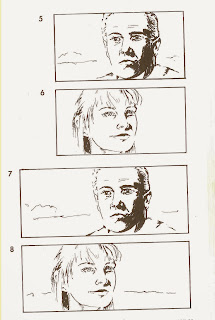
When designing a sequence consisting of two people having a conversation, the OTS can be effective.


A new line of action can be created when another character enters the scene, the board artist can also cut away to a shot of something else in order to change the line of action.


Look at these different shot types and the placement of the characters; try to figure out what is happening in the scene, don't forget to consider the body language and facial expression.


Setting up shots consisting of three or more people is a bit tricky but the line of action or 180 degree rule should still be considered.


Storyboarding

This scene from Leon The Professional breaks the 180 degree rule. Why?


This scene from Lord of the Rings breaks the 180 degree rule. Why?


These are the storyboard panels you will use for your animation pre production there are spaces for ACTION, DIALOGUE and any other NOTES.
Number all pages (top right)
Number all scenes (Sc:)
Indicate the BG (background number) you should re-use these throughout the film so keep going back over your board.