Tuesday, 2 September 2014

Lighting and Mise en Scene


You will carry out tasks based around correct formatting screenplays and scripts.

Key Terms: Planning. Roughs. Script. Annotation.


You will consider the effect of lighting in images and discuss how audiences have been positioned.
Key Terms: High key. Low key. connotations. 


Lighting and colour can be used to create a certain atmosphere or mood
and can even be used symbolically.

Certainly directors are aware of the power of cultural connotations - for example if I say WHITE? -  what associations immediately come to mind… or RED?

Certain genres use colour more obviously than others and you have probably already noticed colours used in  sci-fi?    Horror?

Filmmakers use colour and lighting effects to make audiences well aware of the kind of film they are watching and when teaching your students the basics of film language, here’s what you need to know about lighting effects:

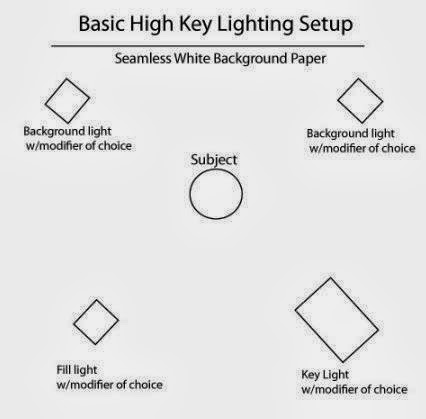
•The basic organisation of  lighting looks like this:


The KEY LIGHT is the term for a powerful light that casts sharp, black shadows behind the things it illuminates. It’s the main source of light in a scene.

FILL LIGHTS can be used to soften these shadows and basically fill them in. More or less of these will be used depending on whether images are to be sharp or soft.
If people or objects are lit from behind it makes them stand out from the background and they become more prominent. Underlighting (from below) and toplighting create different kinds of shadow.

There are two main ways of describing the use of these lights -
HIGH KEY LIGHTING - means the use a lots of fill lights along with the key lights so everything is brightly lit and there are few shadows. This is the style you would expect in romantic comedies, youth pictures, the colour you’d expect from a glossy Hollywood film.


LOW KEY LIGHTING - uses fewer fills, so more shadows are created with definite pools of light interspersed - you might associate this with horror films and is the style of lighting associated with film noir.


Continuation of Pre-Production Research

You will be encouraged to maximise your marks through advice on your approach to continuation of production.


  • Key Terms: Aims, purposes, Codes, Representations, Narrative, Audience, User, Organisational issues.
Posters occupy a space between art and advertising. 
They have a clear commercial purpose - to promote an event or product - but they also have artistic value. People buy them and hang them on their walls. Museums have whole galleries devoted to poster art. 
When analysing a poster in media studies it is important that you evaluate both how well it fulfils its purpose (ie promotion) as well as its aesthetic value.


First steps

What are the main colors used in the poster? What do they connote?

What symbols are used in the poster? Do you need audience foreknowledge to decode the symbols?


What are the main figures/objects/background of the poster? 


Are they represented photographically, graphically, or illustratively?

Are the messages in the poster primarily visual, verbal, or both?Who do you think is the intended audience for the poster?
When analysing a poster, you should consider the following broad questions before you start to focus on the details:
Given that all movie posters have the same purpose - to get audiences to go see a movie - what persuasive techniques are used by the poster?


Critical Evaluation


The audience have to pass judgement on the poster.
  • Is it a good poster?
  • Does it communicate effectively with the audience?
  • Are there any alternative readings which might harm the message of the marketing campaign?
  • Is the poster offensive in any way? e.g. representation
It must be eye catching and captivating to the audience• 
There must be a focal picture that will draw in the audiences eye• 
The title is displayed in a large, eye-catching font• 
It clearly defines the film’s genre• 
The poster should be designed to attract the largest audience possible•

There is usually an indication of when the film is being released – either a date or ‘Coming Soon’, although they are sometimes less specific, for example they might say ‘In Cinemas This Summer’• 

Information on the Directors and Production Company is often displayed in a billing block at the bottom of the poster• 
There could be reviews or titles of other films that the company has made (Cars/Toy Story)

Task 1:
Analyse two of the following posters in detail. (Write in your orange books.)


Examination requirements.


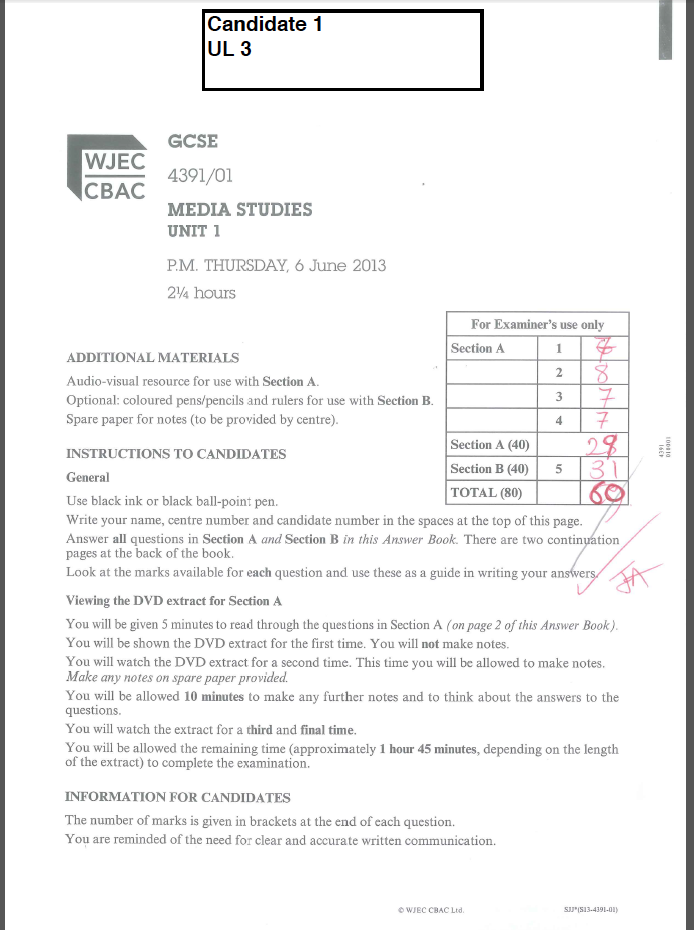
You will take a look at exemplar exam work and evaluate it using the WJEC mark scheme.


Section A: Thinking about the media - Investigating 
Four questions: candidates respond to stimulus material chosen from a topic set by WJEC. This section will also assess the way the contemporary media is convergent. 

Section B: Thinking about the media - Planning 
A series of tasks: candidates demonstrate planning and creative skills through a series of creative tasks which demonstrates knowledge of the convergent nature of the contemporary media. 

____________________________________________________________________________

2.2 The Media Studies framework 
The Media Studies framework will be used to explore all topics. It is based on: 
 texts (genre, narrative and representation issues) 
 organisations (marketing and promotional strategies, regulation and control issues and intrusion & privacy) and 
 audiences and users. 

The convergent and increasingly interdependent nature of contemporary digital media should be studied where appropriate. 


Media Texts: Genre, Narrative and Representation 

For genre, candidates study: 
 generic features, conventions and iconography 
 principles of repetition and variation of a repertoire of elements 
 hybridity 
 intertextuality 
 genres – relationship between organisational and audience/user needs. 

For narrative, candidates study: 
 narrative construction and the role of editing in creating narratives (to include different types of montage) 
 implied narratives – visual organisation, hierarchies and compositional codes 
 narrative structures (based for example on equilibrium, disequilibrium and restoration of equilibrium; binary oppositions and their resolution; open & closed narratives; interactive narratives; linear and non-linear narratives; multi-stranded or flexi-narratives) 
 character functions within narratives 
 settings and locations in which narratives take place. 

For representation, candidates study: 
 what makes representations - images plus points of view about them 
 the processes of 're-presenting' mediated versions of the 'real' world 
 stereotypes and representations - processes of categorisation, identification and recognition 
 the way people and groups of people are represented in the media - in terms of gender, ethnicity, cultural diversity, age and nation 
 the way events and issues are represented in the media. 

Media Organisations: Marketing and Promotion, Regulation and Control Personal, Social and Ethical Dimensions 

For media organisations, candidates study the ways in which media organisations create, sustain and expand their markets and the way they are regulated and controlled. They will also ask questions about personal, social and ethical dimensions in an increasingly convergent media world. 

(a) Marketing and Promotion 
For marketing and promotion, candidates study through their investigation and production work: 
 the ways in which media organisations (such as film organisations, television channels, radio stations, newspapers, magazines, websites, social networks and individuals self-promoting) market, promote and brand themselves in a commercially competitive environment. 

Consideration can be given to such issues as: 
 competition 
 use of stars/celebrities in marketing 
 cross-media campaigns 
 schedules and ratings 
 audience/user research and targeting 
 distribution strategies. 

(b) Regulation and Control 
For regulation and control, candidates study through their investigation and production work: 
 how different types of media are regulated and controlled 
 the reasons for media regulation and control and the problems of regulating within an increasingly global media environment 
 the way individuals can manage their own media. 

Consideration can be given to copyright and fair use, initiatives such as the 'creative commons' and taste and decency. 
(c) Personal, Social and Ethical Dimensions 
For Personal, Social and Ethical Dimensions, candidates study through their investigation and production work: 
 conflicts between individual freedoms and media organisations 
 the personal, social and ethical dimensions of online environments. 

Media Audiences/Users 
For media audiences/users, candidates will study: 

 issues raised by the media for a range of audiences and users, including fans, both in terms of audience/user engagement and audience/user response and interpretation. 

This is likely to involve consideration of: 
 ways of categorising audiences/users and audience/user composition 
 organisational issues such as how audiences are targeted, appealed to, created 
 audience/user response issues such as everyday uses and pleasures together with the different ways audiences and users interpret and interact with a variety of media. 


Continue with Coco Chanel task: Use the guidelines given to analyse the TV ad.

Coursework Requirements. Exemplar work.

You will take a look at exemplar print based work and evaluate it using the WJEC mark scheme.


Magazine: a front cover plus one other page or a double-page spread for younger audience 


(b) Production 

Candidates must complete the production under informal supervision. Teachers may provide support for research, planning and evaluation through group and class approaches. Both candidates and teachers must authenticate work on the appropriate form to accompany controlled assessment. 

For research, individual candidates must provide at least two and no more than four types of evidence of appropriate research. This may take the form of the exploration of comparable examples but may also include some survey work into audiences/users if wished. The evidence may be presented as annotated comparable products, tables, charts and/or digital presentations. 


For planning, candidates must show evidence of at least two and no more than four planning stages. 


For evaluation, candidates must produce their own evaluation of 300-500 words or equivalent, depending on the presentational form selected, which explains how their production: 


  • met its aims and purpose 
  • used appropriate generic conventions 
  • used representations 
  • used narrative (where appropriate) 
  • addressed the chosen or preferred audience(s) and/or user(s) 
  • revealed media organisational issues. 

In the case of a group production, candidates must produce an evaluation which reflects their role. 

Coursework is marked against these assessment objectives:


AO3

 Candidates will be required to demonstrate an ability to: 
Demonstrate research, planning and presentational skills. 

AO4

 Candidates will be required to demonstrate an ability to: 
Construct and evaluate their own products using creative and technical skills. 


Research 10 
Planning 10 
Production 50 
Evaluation 10 


Task 1: 
Mark this production work in accordance with WJEC mark scheme.

Research


Planning


Production


Evaluation