Learning objectives:
Consider how gender is represented in ads
Key terms:
Stereotypes - Simplified representations which focus on certain characteristics of the group and assumes these to be shared across all group members.
Within a stereotype is often a judgement on this characteristic (usually negative – but not always).

Many objects, not just humans, are represented by the media as being particularly masculine or feminine - particularly in advertising - and we grow up with an awareness of what constitutes 'appropriate' characteristics
Task 3: Work in pairs to list objects that are 'gendered' through advertising, given that both sexes will use the product?


Further reading:
Consider how gender is represented in ads
Key terms:
Stereotypes - Simplified representations which focus on certain characteristics of the group and assumes these to be shared across all group members.
Within a stereotype is often a judgement on this characteristic (usually negative – but not always).
Stereotypes are often assumed to be negative as:
1 The judgement making the basis of the stereotype is usually a negative one.
2 They do not allow for individual characteristics to exist in members of the group.
3 They are created by those outside the stereotyped group and are often seen to be an exertion of power – the stereotyped group often has no way to answer back.
4 The stereotype gives a ‘complete picture’ about the group and implies that a knowledge and understanding that can be applied to all members of the group.
Representation of gender
Gender is perhaps the basic category we use for sorting human beings, and it is a key issue when discussing representation. Essential elements of our own identity, and the identities we assume other people to have, come from concepts of gender - what does it mean to be a boy or a girl?
Task 1: Work in pairs and list a table of 'typical' male/female characteristics like the one below.
Typically Masculine
|
Typically feminine
|
Broad
|
Petite
|
Tough
|
Fragile
|
Reliable
|
Needs help
|
Through representation of gender in the media we grow up to believe that men and women like certain things and behave in a particular ways.
Task 2: Copy the lists below and add two things to each column.
Men like:
|
Women like:
|
Technology (cars, gadgets
and computers)
|
Fashion (shopping,
clothes and make-up)
|
Casual sex with many
partners
|
Committed relationships
with one partner
|
Comedy and practical
jokes
|
Celebrity gossip (which
can be ‘bitchy’ or mean to women)
|
Drinking to get drunk
(beers and spirits)
|
Drinking to be sociable
(wines and liqueurs)
|
Computer games like Grand
Theft Auto or Call of Duty on consoles like Play Station 3 or
|
Computer games like Brain
Training on Nintendo DS or Wii
Fit
|
Action / adventure films
|
‘Chick flicks’ and
romantic comedies
|
Task 3: Work in pairs to list objects that are 'gendered' through advertising, given that both sexes will use the product?
Masculine
|
Feminine
|
Sports car
| Cleaning products |
_________________________________________________________________
Different types of male and female stereotypes
Male Stereotypes
· Traditional masculine man – often shown as being muscly, strong, brave, heterosexual, working in manual jobs such as building, plumbing etc. They are often aggressive, tall, and dominant over women, works to provide for family, does no cleaning, cooking or childcare


Task 4:
Define the traditional traits/characteristics of masculinity shown in early representations of men.
Use the films Dirty Harry (1971) and The French Connection (1971) as examples.
· 'New' Man – Often shown as being less masculine but still heterosexual, very peaceful, looks after the family, stays at home to look after family, does cleaning and cooking etc, shown as equal to women. Think David Beckham....
This is from a site called Best Daily:
A new survey reveals the rise of the Metrosexual that shows most blokes now swap the pub for a pedicure and shun traditional 'man's man,' interests.
Face masks, manicures, bubble baths and baking list high on male pampering pursuits and now Lambrini has launched a new drink Ladbrini to meet their changing tastes.
Task 5:
Research and list other examples of new men, list specific examples, their appearance, behaviour and where they have appeared in the media.

This is from a site called Best Daily:
Does your man prefer bubbles to beer? He's not alone.
Face masks, manicures, bubble baths and baking list high on male pampering pursuits and now Lambrini has launched a new drink Ladbrini to meet their changing tastes.
Task 5:
Research and list other examples of new men, list specific examples, their appearance, behaviour and where they have appeared in the media.

· Gay Man – Often shown as being very feminine, weak, working in jobs such as fashion or hairdressing, bitchy, etc

What persuasive techniques are used?
What does the man's appearance tell us about him.
What does the man's behaviour tell us?
Who would the ad appeal to and why?


Task 6: Research and list gay men in the media and write a paragraph about how they challenge traditional notions of masculinity. Consider costume, language used, behaviour.

Task 7: Write about 200 words about how men are represented in the TV ad below. Also consider the persuasive techniques used in the ad:
Homework. To be submitted on Monday. Detentions will be issued to those not completing this task
What persuasive techniques are used?
What does the man's appearance tell us about him.
What does the man's behaviour tell us?
Who would the ad appeal to and why?
____________________________________________________________
Patriarchal Society
Traditionally, men have held the power in our society.
The system where men have power and control in society is called patriarchy.
It is understood as a society run by men for men.
The result of patriarchy is that traditionally male qualities and attributes are generally seen as superior to traditionally female qualities and attributes.
Rupert Murdoch
The CEOs and heads of most big businesses are male, including those in the media. They naturally (unconsciously?) promote their own qualities as superior through the ideological makeup of the texts they produce.
Action films often link to patriarchal ideas about gender
_________________________________________________________________
Task 1:
Research and write down a definition of patriarchy.
_________________________________________________________________
Women in advertising
Female stereotypes
Female representation in advertising is based on certain criteria such as
- Maternal
- Jobless
- Seductive/provocative
- Dependent on a man
- Unintelligent/dizzy
- Manipulative.
Advertisers tend to focus on body image, inadequacy and subservience.
Therefore, women tend to be more conscious about their weight and beauty.
Advertisements place females in a neglected role and males in a dominant one.


Task2:
Research and download three images of women in advertising that conform to the criteria discussed (see above). Write down how the appearance and behaviour of the women in the ads contributes to the stereotype. Powerpoint Presentation or word doc.
________________________________________________________________
Female stereotypes
Traditional feminine woman – often shown as being girly, likes pink, wears dresses, does feminine jobs such as working in fashion, hairdressing or stays at home to look after the children, needs a man to cope, weak, scared of things, needs rescuing, pure and innocent.
Two of the most common traditional roles women were represented in under patriarchy were the happy housewife and the sex object/ glamorous ideal.
Task 3: Research and list traditional feminine 'types' of women in today's media list specific examples, their appearance, behaviour and media texts that they have appeared in.
Write down how the appearance and behaviour of the women you have researched contributes to the stereotype. Powerpoint Presentation or word doc.
Sexy woman – very flirty, dresses in a revealing way, more powerful than traditional women, uses ..men to get what she wants, no loyalty to other women, bitchy.

Task 4: Research and list of 'flirty' women in today's media list specific examples, their appearance, behaviour and media texts that they have appeared in. Music industry is a good place to start. Write down how the appearance and behaviour of the women you have researched contributes to the stereotype. Powerpoint Presentation or word doc.
Lesbian Woman – Often shown as dressing in a masculine fashion, doing masculine roles, hating men, looking masculine.


Women:
Task 5:
Research and download images of lesbian women in today's media give specific examples, their appearance, behaviour and media texts that they have appeared in. Write down how the appearance and behaviour of the women you have researched contributes to the stereotype. Powerpoint Presentation or word doc.
____________________________________________________________
From the 1960s onwards, feminism challenged patriarchy. Feminism sought to gain equality for women and argued that changing representations in the media was vital to do so.
Feminism resulted in anti-sexism legislation and increased respect and opportunities for women. Suddenly gender roles were less defined in real life and this was reflected in media representations.
The representation of women in the media has developed and adapted to reflect changes in how society views them.
As women's roles in society have changed, this has been reflected in some areas of the media.
As women's roles in society have changed, this has been reflected in some areas of the media.
However, there are still some stereotypical representations of women where they are defined by how men see them and how society expects them to look and behave.
Women still tend to be judged on their looks and appearance foremost.
Representations tend to concentrate also on their sexuality; emotions and narratives tend to be based around relationships.
The way in which the representation of women is constructed in texts like glamour magazines is unrealistic and instills unattainable aspiration in the audience.
In an examination response it is important that you explore the representation of gender at a sophisticated level and go beyond basic discussion of positive and negative, it is much more complex than that.
_______________________________________________________________________
Further reading:
The representation of Fearn Cotton as the cover image on Cosmopolitan (October 2011) magazine would appeal to both men and women.



In simple terms, women want to BE her and men want to BE WITH her.
The cover line related to her defines her very much in terms of a relationship and of emotions;
'Being in Love'.
The image is constructed through visual codes, costume and mode of address.
The image is ambiguous; her posture and body language are strong but she is also very sexualised.
She is defined in terms of her body image and her size.
By highlighting her 'firm thighs' the magazine presents this representation as that which every women should aspire to.
The other cover lines suggest the discourse of the magazine and represent women in terms of beauty, sex and consumerism.
The sell lines of 'miracle beauty buys' gives hope to those readers who do not look like the female construction of the magazine. The representation is obviously unrealistic and the construction includes image manipulation such as airbrushing to give a representation of perfection. Unattainable for most ordinary women.
When you are discussing areas of representation such as stereotyping, you must be sure to analyse the representation according to the context in which it appears and the purpose.
_______________________________________________________________________________
Subversion of stereotypes
Whilst there remain many stereotypical representations of women in the media, there are also texts that are constructed to challenge these representations. These texts hold messages that offer a more realistic or refreshing representation of women in the media today. In film and television we see more and more women who have key roles and that are active rather than passive. They are defined by what they do, rather tan what is done to them. They are less the victim and more the hero.

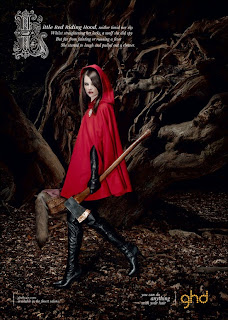
Some texts cleverly play with accepted stereotypes in order to challenge them. This is true of the GHD hair straighteners Twisted Fairytales campaign.
Here the stereotypical representations of women are subverted to create strong women who do not have to rely on men to rescue them. The campaign uses Rapunzel, Cinderella and Little Red Riding hood, in each case they leave the stereotypical male hero behind in a twist at the end.
In the print advert above, RRH is shown to be both sexually attractive and purposeful. She engages in a direct mode of address with the audience. The iconography and graphics remain that of a fairytale but the representation is very different (as the rhyme indicates)..
However, it is also true that, although the women are strong and independent and over come the men in the GHD campaign, they are also stereotypically beautiful and it is their beauty aid, hair straighteners that are deemed responsible for their success.
In this respect, the representation of women in the campaign is ambiguous.
Economical Issues with Gender
- Economically, women still have trouble finding jobs because of their gender.
- Often times men will make more money than women in the workforce.
- It is rare to find females with higher wages in the same occupation.
- In the 2008 Presidential Elections, it was the first time ever a woman has made it to the primary elections.
Objectification
Objectification is a notion central to feminist theory. It can be roughly defined as the seeing and/or treating a person, usually a woman, as an object.
Task:
Write 200 words about the representation of women in the ad below.
What messages does the ad send?

___________________________________________________________________
Men:
Key terms:
New man - this was a term introduced to describe a new breed of men. These men rejected sexist attitudes; were in touch with their feminine side and were therefore not afraid to be sensitive, caring and could sometimes be seen in a domestic role.
A good example of a media text that reflects this changing role is James Bond, here the representation of men has become more acceptable.
Key Figure:
David Gauntlett - in his book 'Media, gender and identity considers the changing representations of men and women in the media. He also discusses the Pick and Mix theory. This suggests that audiences are active rather than passive and will choose what to do with the media rather than having the media manipulate them.
Stereotypically, men in media texts are represented differently from women but their representation, like that of women, has changed in order to address changes in society.
There have been many cries that masculinity is in crisis and that men no longer have a traditional role to play in society as they once did.
However it is the case that men, just like women have had to change their roles and this has been reflected in their representation across a range of media texts. With the advent of the 'new man' there appeared different representations of masculinity.
However, even when disguised as a new man, representations of men in the media still tend to focus on the following:
- Body image and physique
- Physical strength
- Sexual attractiveness and relationships with women
- Power and independence
One media area that has developed dramatically is the men's magazine market. Now men as well as women are given aspirational and unrealistic role models to emulate.
Men too have to be concerned about their weight and body imageand buy into an unattainable lifestyle through the representations presented to them.
Men's Health magazine is now the best selling men's magazine, overtaking FHM in 2010.
Below is a constructed image that defines men very clearly.

The central image is one of perfection and has clearly been manipulated to present the 'perfect body' image.
The mode of address is direct and the use of imperatives is commanding and powerful.
However, as this is a new man, he is also concerned about his health and his diet, but reverts to a more traditional type, refering to sex rather than relationships.
The cover lines include quick fix problem solving to suggest a healthy lifestyle and acquiring this body is easy.
The body language of the model suggests that he is proud of his shape and is self obsessed, looking away from the audience.
However, there still exist in the media the more stereotypical representations of men in strong roles defined by their power, independence and their ability to survive against all the odds. These representations tend to be associated with particular genres, for example the action film, still largely the domain of the male protagonist.


In Casino Royale and Quantum of Solace, the audience is presented with James Bond, the action hero. The iconography that places him in this role is evident in these stills from the film; dinner suit, gun, action shot and the beautiful woman.
However, on closer analysis, this representation is more ambiguous and reflects the new man that is James Bond.
The woman is not an accessory; she is next to him and has clearly been part of the action. His bow tier is missing and his suit is dishevlled. His expression is not the usual cool and calm, but moody and unhappy. In another shot he is seen as protecting the female and looking intimidated himself. Different to the old James Bond.
Task 1:
Write 200 around words on the representation of men in the three texts,
American Sniper,
Casino Royale and
Men's Health.


